
By Lerato Pooe
Speakers at an African Women in Media webinar urged journalists to rethink editorial, images and language choices when reporting violence on women and girls.
A story about violence against women and girls can do more than inform the public. The choice of words, images published and details chosen by journalists can shape how audiences understand what happened and, in some cases, expose survivors to further harm.
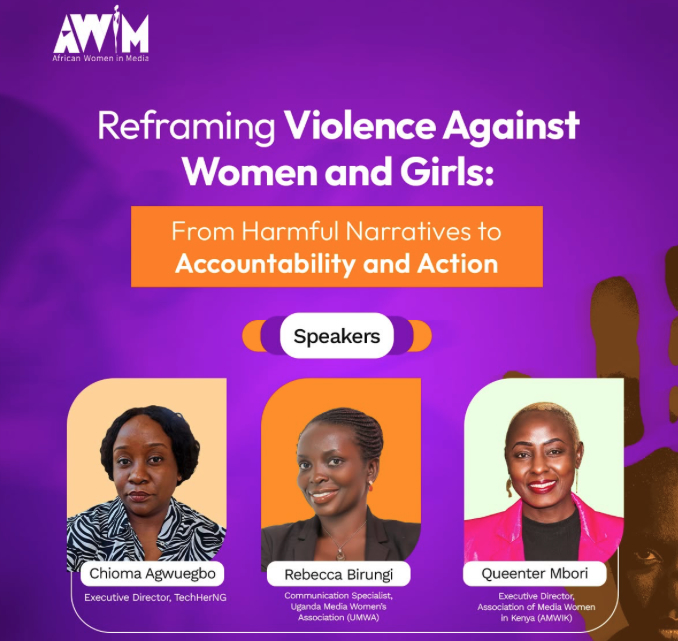
This was a key concern raised by speakers at the African Women in Media (AWiM) public webinar held on Thursday, 08 August 2026.
The session, titled Reframing Violence Against Women and Girls: From Harmful narratives and to Accountability and Action brought together journalists, editors, media trainers, gender advocates, digital rights actors and other media and accountability stakeholders from across the continent to examine how reporting can either harm or protect survivors’ dignity.
One of the key speakers, Chioma Agwuegbo, Executive Director, TechHerNG, said violence has always existed in forms that we have become accustomed to: I think what we can say has changed is the format. The harms have always existed,” she said.
Agwuegbo said the wide existence of the internet means that once harmful information is published, it can spread wider and faster, becoming almost impossible to remove completely despite legal mechanisms such as the right to be forgotten. “Whether we like it or not, the internet never forgets,” she said.
Moderator Lobna Msilini added that it was “important to remember that the story does not end when it’s published, sometimes that is when another wave of harm begins”.
When talking about practising survivor-centred reporting, Rebecca Birungi, Communication Specialist, Uganda Media Women’s Association (UMWA) noted the importance of engaging the survivor in the story instead of interrogating them. “It’s not just solution-based journalism, but also it involves the other party into what you’re going to do.” she says.
This means fully respecting the survivor, having them shape how their stories are told and briefing the editor about decisions, including what they are comfortable discussing and how they want to be identified. “If the person may request that they wouldn’t want their face or their voice to be known, then you have to know how to alter the voice,” she said.
Birungi also says survivor-centred reporting means that journalists do more than just reporting, they offer solutions to survivors. By consulting Gender Based Violence (GBV) activists, legal experts and relevant institutions, they can help provide context on the laws and services available to survivors, including health services where necessary.
Queenter Mbori, Executive Director, Association of Media Women in Kenya (AMWIK) highlighted that language used in media regularly sensationalises matters of GBV. She said cases are often framed as “love triangles” or isolated incidents, which can romanticise violence and contribute to victim blaming. “We talk about partial crimes. We try and make it flamboyant, yet this is a very pertinent issue that needs to be called out for what it is,” she said.
She also noted that the language implied by the media, such as labelling sexual matters and gender-based violence crimes as mysterious deaths or dead gold has completely stripped the crime of its gender-based systematic nature.
Mbori suggested that reporters need to be more deliberate in the language that they use: “We must adopt standard terminology explicitly calling sexual and gender-based violence as it is, as advocated perhaps in our legal framework in Kenya.”
Mbori pointed to victim blaming and called out articles for highlighting where the victim was at night, what they are wearing, their financial status and social life.
Agwuegbo gave an example from Nigeria involving a woman who accused a famous musician of rape. She noted that media outlets used a photograph of the woman in a bikini alongside a photograph of the artist wearing a three-piece suit, despite the artist being known for performing shirtless. She pointed that the woman was not a public figure and the photograph was sourced from her Instagram account.
Agwuegbo said the choice of images contributed to the immediate backlash against the woman, with people questioning her clothing and using it to project doubts on her allegation. She argued that such editorial choices stack information against the victim and influence audiences to focus on her clothing instead. “Report the system, not the body,” she said.
Beyond the language and images used in GBV reporting, Mbori also highlighted that, often when a gender-based violence case is reported, the media’s attention is more on the survivor or the victim than the accused. She urged the media to shift its focus, explaining that little focus on the perpetrator means that they remain invisible. “We also need to focus on perpetrator accountability,” she said.
Other participants also called for continuous discussions and training for journalists reporting on gender-based violence, rather than treating such guidance as a once-off exercise.
Ultimately, speakers emphasised that responsible reporting does not only include avoidance of harmful language or images but also recognises that some editorial decisions can compromise the survivor’s safety and dignity.


