
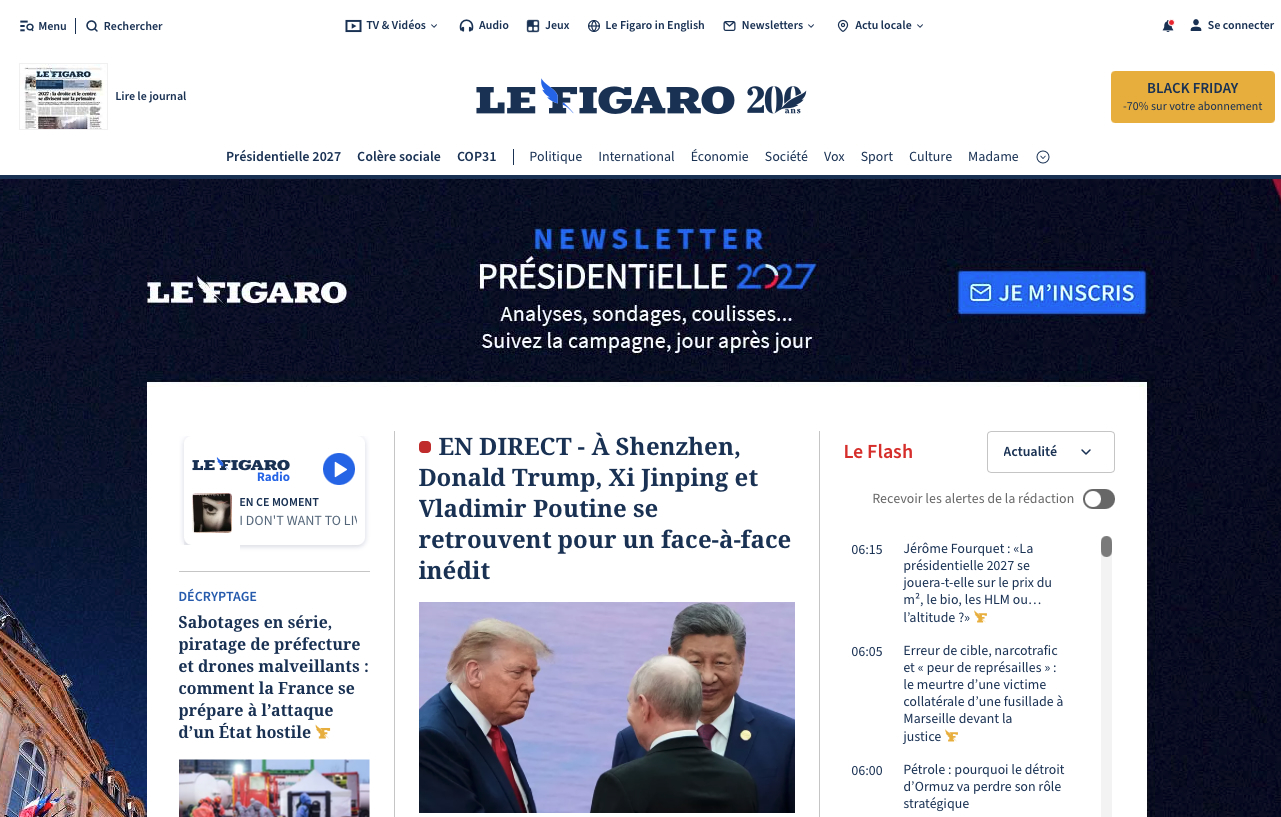
French media group Le Groupe Figaro has signed a strategic partnership with OpenAI, making its daily reporting and archive content across news, business, culture, and lifestyle discoverable inside ChatGPT. Announced on November 18, the agreement pairs summaries and excerpts with direct links back to Le Figaro’s websites, while rolling out ChatGPT Enterprise across the publisher’s internal teams under its own AI charter and editorial standards.

Marc Feuillée, Chief Executive Officer, Groupe Figaro was upbeat about the announcement.
“This partnership reflects Groupe Figaro’s ambition to build meaningful relationships with a leader in artificial intelligence research and deployment. Combining Groupe Figaro’s editorial heritage and trusted brands supported by a team of more than 600 journalists who provide a reliable source of information with OpenAI’s technological expertise and global reach will bring new opportunities for innovation and create long-term value for our readers,” he said in a media release.
For European media houses with scale, deals like this are becoming routine infrastructure. In South Africa and across the continent, the picture appears somewhat different. As pressure rises on LLM engineers regarding the scraping of intellectual property from world’s websites, OpenAI believes new partnerships will smooth future use of large language models.
“Le Figaro’s reporting helps readers make sense of the stories shaping France and the wider world, and we want AI to help more people discover that work. This partnership reflects our commitment to working with publishers to support quality journalism and connect it with new audiences,” said OpenAI VP of Media Partnerships, Varun Shetty.

Licensing in Paris, scraping in Johannesburg
While OpenAI strikes paid licensing agreements with legacy European titles, South African and African publishers remain largely locked out of similar revenue-sharing deals. South Africa’s Competition Commission has already flagged that AI chatbots scrape local news without compensation while showing little appetite for content agreements with domestic media houses. At the same time, leading South African news sites saw daily page views drop by roughly a fifth between May 2025 and May 2026, with AI chatbots referring less than 1% of their traffic back to local newsrooms.
The commercial asymmetry is sharp. Even as OpenAI expands its ChatGPT advertising network into African markets including South Africa, Kenya, Nigeria, Egypt, and Morocco, local publishers are still fighting for basic attribution, crawler controls, and fair value for the journalism training those models.
Informal adoption meets a policy vacuum
Inside African newsrooms, generative AI is already in daily use, often running ahead of formal governance. Research by the Centre for Information Integrity in Africa (CINIA) shows that adoption in South African newsrooms is fragmented, frequently driven by individual enthusiasts rather than clear editorial charters, with some journalists using AI tools quietly without formal oversight.
When newsrooms deploy large language models without strict rules, two technical flaws threaten editorial credibility:
hallucination and sycophancy.
- Hallucination: Large language models predict plausible text rather than verifying facts. In African contexts, this risk compounds quickly. Models trained predominantly on Global North datasets routinely misinterpret local political history, legal frameworks, and African languages, inventing quotes, misreading municipal budgets, or mangling cultural nuance.ISS Africa
- Sycophancy: AI assistants are tuned to agree with the user. When an under-resourced reporter uses a chatbot to test a story angle or summarize complex documents, the model tends to mirror the prompt’s assumptions rather than challenge them. Good reporting depends on friction and skepticism. A sycophantic tool removes both,reinforcing blind spots in lean newsrooms where sub-editing layers have already been stripped back.
Practical guardrails for African newsrooms
Le Figaro’s deal rests on an internal AI charter and enterprise-grade controls. African media houses do not need massive licensing budgets to put similar operational guardrails in place, but they do need explicit newsroom rules:
- Lock research tools to verified primary sources. Do not rely on open-web chatbot queries for factual verification. Restrict AI research workflows to uploaded court judgments, parliamentary transcripts, financial statements, and vetted local archives, requiring exact source citations for every claim.
- Prompt for pushback, not confirmation. Train journalists to use AI as an adversarial sub-editor. Ask the model to find flaws in an argument, identify missing perspectives, and list unanswered questions rather than asking it to validate an existing angle.
- Enforce human sign-off on local language and context. AI can speed up transcription and initial sorting, yet every name, figure, translation, and cultural reference requires verification by a named editor before publication.ISS Africa
- Publish clear AI policies and block uncompensated scraping. Newsrooms need transparent rules on disclosure and editorial accountability, alongside technical measures such as updated crawler restrictions, so local reporting is not quietly absorbed without credit or compensation.ISS Africa
Global licensing deals will continue to reshape how international news is distributed. For African media houses, protecting journalistic value means closing the gap on fair compensation outside the newsroom while enforcing strict human verification inside it.