The global economy in 2026 is defined by a striking paradox where the artificial intelligence revolution has driven unprecedented capital expenditure, lifted technological manufacturing and fueled stock market highs. On the other hand, geopolitical conflict in the Middle East continues to strain energy supplies, disrupt global trade routes, and push living costs higher for millions.*
According to the International Monetary Fund’s (IMF) July 2026 World Economic Outlook Update, global growth is projected to slow to 3.0% in 2026 before edging up to 3.4% in 2027. Beneath these aggregate numbers lies a identifiable structural divide that has revealed a two-speed world where a select group of tech-integrated economies thrives on digital acceleration, while developing nations are left to navigate the brunt of supply-side inflation.
For Southern Africa and the broader continent, this moment presents a threat that extends beyond fiscal policy. Global capital and headline attention has fixated on the Silicon Valley narrative while Africa’s economic reality risks being mispriced, misunderstood, or even erased. Navigating this environment demands a strategic narrative approach.
The Asymmetric Reality of the Global Economy
The IMF characterizes the current global landscape as a tug-of-war between two opposing forces: a negative supply shock induced by conflict in the Middle East and a positive demand shock powered by the global technology cycle.
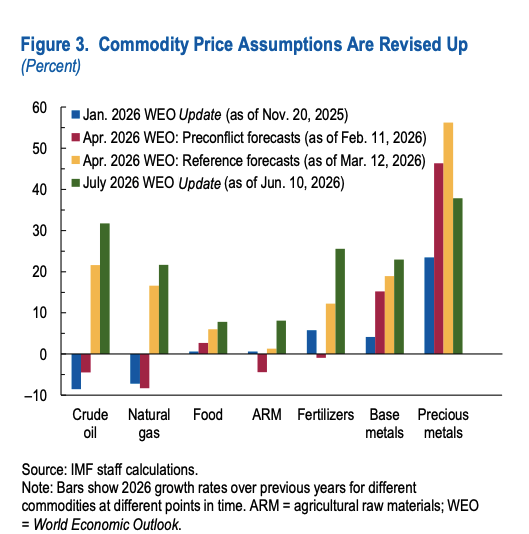
While severe commodity price spikes have been somewhat tempered by strategic inventory drawdowns, energy costs remain structurally high. Average crude oil prices are projected at $89 per barrel for 2026—a 9% increase over earlier forecasts—while natural gas and fertilizer prices have jumped by 22% and 26% respectively. Consequently, global headline inflation has stalled its downward trajectory, rising to 4.7% in 2026.
Global Economic Indicators (IMF July 2026 WEO Update)
——————————————————-
Global GDP Growth (2026): 3.0% (Down from 3.5% in 2024-25)
Global Headline Inflation: 4.7% (Up from 4.1% in 2025)
Average Crude Oil Spot Price: $89/barrel (Up 9% vs. April forecast)
SSA Regional Growth (2026): 4.3% (Broadly stable, but uneven)
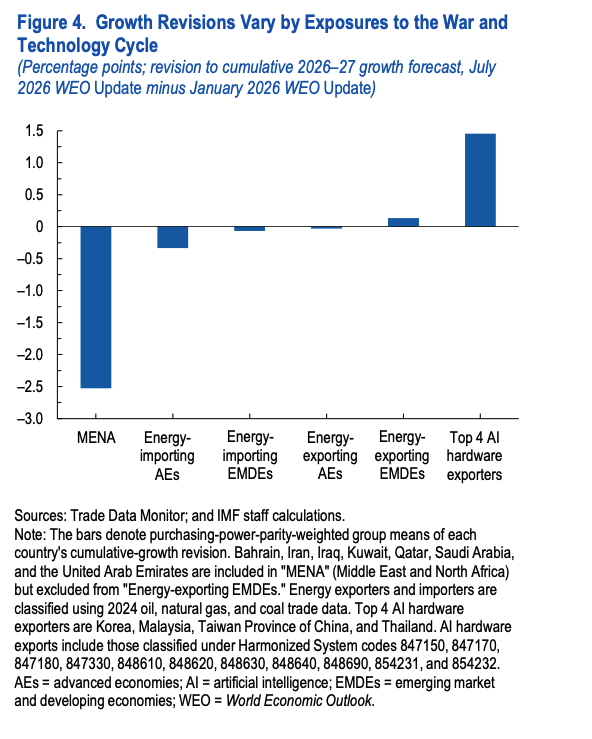
Yet, the impact of these headwinds is extraordinarily uneven. Economies embedded in the AI hardware supply chain such as South Korea, Taiwan, Malaysia, and Vietnam, have posted strong growth surprises, leveraging a boom in semiconductor and server exports to offset higher energy import costs. Construction of data centres has also been a boon for companies poised to take advantage of this moment.
Conversely, energy-importing emerging markets and low-income countries with minimal participation in the high-tech value chain face a compounding penalty. Higher fuel and food import bills paired with tightening global monetary conditions and shrinking official development assistance (ODA) has led to further skewing of the economic balance.
Southern Africa in the Crosscurrents
Sub-Saharan Africa’s growth is projected to remain relatively stable at 4.3% in 2026. However, this figure conceals stark internal disparities.
The core vulnerability for the region stems from its near-total absence from the global AI capital expenditure wave. While advanced economies and East Asian hardware hubs draw hundreds of billions in technology investments, non-resource-intensive African nations are absorbed by the immediate mechanics of shock absorption such as managing volatile food import bills, defending local currencies, and servicing debt in a high-interest environment.
In the Southern African Development Community (SADC), the economic trajectory reflects these constrained choices:
- South Africa’s Muted Stabilization: Growth in South Africa is projected at a modest 1.1% for 2026, rising slightly to 1.3% in 2027. Strengthened policy frameworks and ongoing structural reforms—particularly in energy production and freight logistics—are providing a floor for recovery, but overall momentum remains constrained by high borrowing costs and weak domestic demand.
- Exhausted Fiscal Buffers: Across the wider SADC region, governments responded to the Middle East shock by implementing targeted fuel tax cuts, electricity subsidies, and price controls. However, the IMF explicitly warns that these policy buffers are now depleted. With public debt levels elevated, countries must phase out broad-based subsidies in favor of tightly targeted social safety nets to preserve fiscal sustainability.
- The Cost-of-Living Squeeze: Rising fertilizer and energy costs directly impact smallholder agriculture and urban logistics across Southern Africa. Without the growth engine of high-tech exports, the region risks seeing basic essential inflation trigger severe food insecurity and heightened social friction.
The Comms Imperative: Why Narrative Sovereignty is Economic Security
When analyzing the IMF update, one sentence stands out as a critical guidepost for business leaders and policy makers: “Under elevated uncertainty, communication is itself a policy tool.”
The IMF applies this insight primarily to central banks seeking to anchor inflation expectations. However, in the context of the business of communication, its implications are far broader.
In a global financial landscape obsessed with artificial intelligence metrics, the narrative surrounding African growth is in danger of being simplified into a story of passive exposure. When international capital markets evaluate the African continent purely through the lens of headline inflation, debt distress, and geopolitical vulnerability, capital becomes artificially expensive, local innovations are overwhelmed, and cross-border investment stalls.
This is where strategic communication shifts from a transactional support function—writing press releases or editing corporate reports—to an active driver of economic resilience.
At frayintermedia, our work across the continent rests on a core mandate of changing narratives through rigorous, insightful storytelling. In an era dominated by global algorithmic noise and hype cycles, African institutions, civil society organizations, and corporate leaders must take active ownership of their economic narratives.
1. Reclaiming the Story from the Hype Cycle
Africa’s economic story cannot be reduced to a zero-sum analysis that pivots on the axle of microchip manufacturing. The continent sits at the heart of critical global transitions and holds most key minerals required for the green energy transition, possessing a young, digitally native workforce, and driving rapid innovation in mobile finance, climate adaptation, and logistics. Communicators must articulate these structural fundamentals clearly to ensure international investors look beyond short-term global noise.
That is one of the reasons why frayintermedia has developed a relationship with the Global Fund for a New Economy and assisted the fund in setting up its hub in South Africa. The new SA Comms Hub is tasked with sourcing and training spokespeople who understand the relevance of a global approach to dealing with systemic weaknesses in the current economic structure of business.
2. Communicating Reform with Transparency
As SADC governments navigate painful fiscal adjustments such as removing fuel subsidies and rationalizing public expenditure, clear, proactive communication becomes the primary defense against policy instability. Trust is built when public and private sector leaders transparently communicate why choices are made, how vulnerable households are being protected, and where long-term value is being created.
3. Elevating Local Solutions for Global Audiences
Whether documenting sustainable groundwater management in the SADC region, tracking digital financial inclusion, or reporting on regional trade integration under the AfCFTA, high-quality development journalism and strategic communication bridge the gap between policy intent and public understanding.
Beyond risk mitigation, proactive strategic communication serves as a powerful engine for reshaping thought leadership and reframing global market perceptions. When African organizations move past passive reporting and instead leverage data-backed storytelling, they actively disrupt the international investor echo chamber that frequently misprices regional risk.
Strategic narrative management shifts the continental dialogue from one of baseline vulnerability to one of structural opportunity, proving that systemic challenges such as energy transitions, logistics bottlenecks, or digital equity, are fertile ground for sustainable innovation. A clear real-world illustration of this narrative shift is Project Kilimanjaro, a donor-funded initiative managed by frayintermedia in partnership with Africa No Filter.
By using targeted media series and narrative development to re-examine Africa’s cotton industry, the project deliberately dismantles old, victim-centric agricultural tropes. Instead, it repositioned the sector in the eyes of global stakeholders, highlighting regional value addition, industrial sustainability, and local economic agency. This demonstrates that when communicators ground their messaging in rigorous, strategic narratives, they can fundamentally reset how international capital and global institutions perceive, value, and engage with the African growth story.
Navigating the Two-Speed World
The IMF’s July 2026 report paints a sobering picture of a divided global economy. As advanced markets and tech hubs build the digital infrastructure of tomorrow, Southern Africa must contend with the tangible cost pressures of today.
Economic destiny is not determined solely by external shocks or technology cycles, it is also shaped by policy execution, institutional agility, and the way in which a region defines its value to the world. For communicators, journalists, and leaders across Africa, it is imperative to ensure that while the world listens to the rumble of the AI revolution, the strategic weight, resilience, and untapped potential of the African growth story are heard loud and clear.
*Writer’s Note: ChatGPT was used to analyse the initial data sheet from the IMF. Gemini was used to generate a useful running order of facts. frayintermedia’s Des Latham wrote the copy, inserted the IMF graphs, and generated the strategic thinking in this piece. The author is a certified Large Language Model Prompt Engineer and Data Analyst.