
Africa’s media industry is entering a period of rapid change as advertising, streaming, digital platforms and artificial intelligence reshape how audiences consume news and how media organisations generate revenue.
A recently published report projects that the global entertainment and media industry will reach US$4.2 trillion by 2030, driven by advertising, streaming, digital platforms and emerging technologies.
PwC’s Global Entertainment & Media Outlook 2026–30 puts the industry at US$3.5 trillion in 2025 after 5.3 percent growth during the year. It expects the sector to expand at a compound annual growth rate of 3.4 percent through 2030. Advertising alone passed US$1 trillion in 2025 and is expected to reach US$1.4 trillion by the end of the decade.
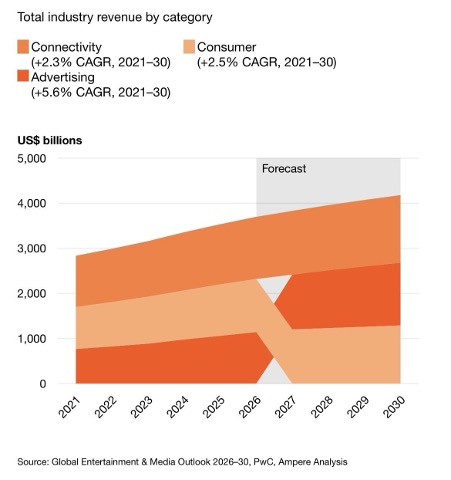
The figures point to a media industry with significant commercial growth ahead. They also expose a widening tension for journalism. More money is entering the broader media ecosystem while audiences are moving away from traditional distribution channels, subscription fatigue is increasing and artificial intelligence is changing how content is produced and consumed.
“Good stories sell, and this applies equally to the story we tell about why, as media, we are valuable enough for a subscription.”
TinaShe Mac Makwande
South African media organisations are operating inside this shift while facing the additional pressure of a relatively small advertising market and audiences accustomed to accessing news across multiple digital platforms.
TinaShe Mac Makwande, Founder of Starquo, argues that the scale of the projected growth matters less than whether media organisations can identify where the opportunities are.
“The growth tells us that there are more opportunities available to media organisations, but we need to be clear about where they are and how they apply to us.”
South African media already has material that travels beyond the country’s borders. Makwande points to productions such as The Polygamist, South African footballers playing in Europe and the Springboks’ match against the All Blacks in Baltimore as examples of local stories and talent generating international attention.
Developing content for international audiences could allow South African media companies to reach markets with stronger advertising yields while building audiences beyond the limits of the domestic market.
The subscription squeeze
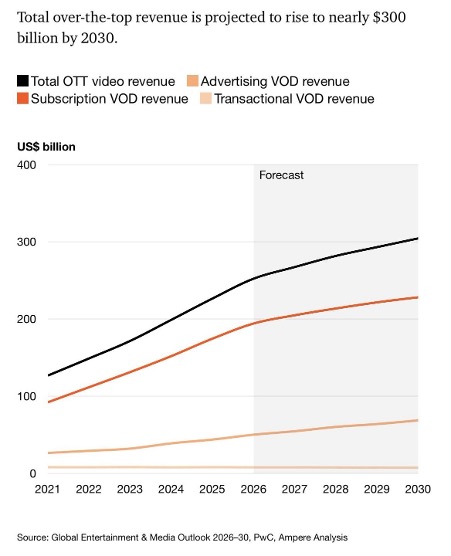
PwC expects subscription fatigue to remain a challenge in mature markets even as streaming continues to expand. Global OTT revenue increased 13.9 percent in 2025 to US$226.6 billion and is projected to reach US$304 billion by 2030. Advertising is expected to account for a growing share of OTT revenue, rising from 19.4 percent to 22.6 percent over the same period.
Publishers cannot assume that audiences will continue paying simply because more content is placed behind a paywall.
Makwande argues that publishers need to examine the product behind the subscription and understand what audiences actually value.
“Good stories sell, and this applies equally to the story we tell about why, as media, we are valuable enough for a subscription.”
The product itself has to keep changing. Convenience, access and the range of services attached to a subscription can determine whether an audience sees continued value in paying.
Paula Fray, CEO of fraymedia Foundation, argues that audiences are unlikely to pay for general information available across multiple platforms. The stronger opportunity lies in journalism that connects directly to people’s work, identities, interests or locations.
Revenue diversification is therefore becoming increasingly important. Subscriptions and memberships can sit alongside events, commercial partnerships, specialist products, training, syndication, philanthropy and services built around newsroom expertise.
The commercial model still has to protect editorial independence. Trust remains an asset that cannot be separated from the business of journalism.
The wider entertainment industry is already responding to subscription fatigue through bundling and partnerships. PwC expects these arrangements to become increasingly important as companies compete for audiences facing an expanding number of subscription choices.
AI arrives before every newsroom is ready
PwC expects AI to influence almost every stage of the entertainment and media value chain, including content creation, distribution, advertising, recommendations and audience targeting. The report also notes that human craft, experience and delivery will remain central even as AI becomes embedded in media workflows.
Fray says readiness is mixed: “Preparedness is uneven. South African newsrooms understand that AI and digital platforms will reshape the industry, but understanding the shift is not the same as being ready for it.”
Larger organisations have begun developing strategies and policies around AI, while smaller newsrooms often lack the resources to establish formal frameworks.
The technology is already changing journalism through transcription, translation, research, data analysis, production and distribution. It can reduce the time required for routine tasks and allow small teams to operate with capabilities that previously required greater financial and human resources.
“In an overcrowded and unreliable information environment, verification, context and accountability become more important.”
Paula fray
AI systems can reproduce dominant voices and information already available online, creating the possibility of a media environment that becomes increasingly repetitive rather than more diverse.
Makwande sees the technology as an opportunity to increase capacity, particularly for smaller organisations that cannot afford large teams or expensive production systems.
Tools such as ChatGPT Plus and Claude Pro cost relatively little compared with the capabilities they provide, creating access to technologies that would previously have required significantly larger budgets.
The resulting efficiency, however, only matters when organisations know where to direct the additional capacity.
“The important question is what we do with that capacity, which outputs we prioritise and which audience or revenue need the work serves.”
The newsroom is no longer the front door
The traditional relationship between publisher and audience has also been disrupted.
Audiences increasingly encounter journalism through social platforms, messaging groups, search engines, creators and recommendation systems. PwC notes that discovery is moving away from traditional schedules and editorial curation towards feeds and personalised recommendation systems.
The newsroom is no longer guaranteed to be the first point of contact.
Fray argues that the shift has made the work of journalism more important rather than less relevant.
“In an overcrowded and unreliable information environment, verification, context and accountability become more important.”
The change also creates an opportunity for media organisations to build relationships beyond publishing.
“They should not see themselves only as publishers of content but also as conveners of communities.”
Advertising money has moved
Advertising remains one of the strongest parts of the global media economy, but the growth is concentrated increasingly in digital ecosystems.
Internet advertising grew 12.2 percent in 2025 to US$755.6 billion and is projected to approach US$1.1 trillion by 2030.
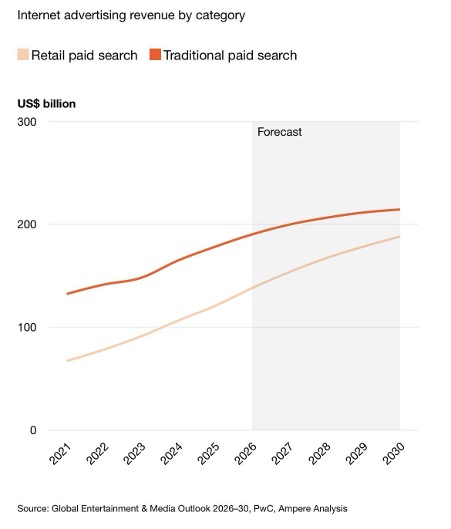
Search, social platforms and retail media have built advertising businesses around data, targeting and scale. PwC projects retail paid search revenue to grow at a 9.3 percent compound annual rate to US$188.2 billion by 2030.
That growth creates a difficult environment for publishers competing for advertising budgets against platforms with significantly larger audiences and more sophisticated targeting systems.
Christopher Mcinga, Publisher and Business Developer at Student Living SA, a MeD8 Media publication, experienced the vulnerability of relying on traditional advertising during the COVID-19 pandemic.
When the publication moved away from print, it lost about 90 percent of its income. The response was not to rebuild the business around conventional advertising but to diversify its commercial base.
“We’ve diversified into events, sponsorships, and sponsored content, with support from other MeD8 Media revenue streams.”
Advertising remains part of the business model, but publishers increasingly need revenue streams that they can influence directly.
Events create physical relationships with audiences. Sponsorships can connect commercial partners with defined communities.
The shortcut has a cost
The pressure to produce more content at lower cost has created another fault line around AI.
Mcinga says Student Living SA has seen an increase in journalism students submitting work that appears to have been drafted or assisted by AI despite the publication’s policy.
The publication requires students to submit their original work before using AI for limited functions such as sentence structure and headlines.
“This isn’t just a style preference. It protects the integrity of our accuracy checks and guards against the risk of hallucinated facts slipping into published work.”
The concern extends beyond factual accuracy. Journalism training is also about developing a voice, learning how to report and building credibility with an audience.
Mcinga sees the newsroom as a training ground where journalism, public relations and arts students can develop that identity through original work.
“That’s something AI can’t replicate, and it’s central to our mission of impact before profit.”
A newsroom that sacrifices original reporting for speed may reduce production costs while weakening the credibility that gives its journalism value.
Growth is not the same as sustainability
PwC’s projections show an entertainment and media industry that is continuing to expand. Advertising is approaching new highs, streaming is growing, immersive experiences are gaining commercial traction and AI is becoming embedded across the value chain.
Yet the expansion of the wider industry does not automatically strengthen journalism.
The central challenge for South African media is to identify where value is being created and develop businesses capable of capturing it without compromising editorial independence.


